57 TikTok Ad Hooks (and the AI Prompt We Use to Write 100 More)
The first two seconds decide whether your TikTok ad works. Here are 57 proven hook templates organized by psychological trigger, how to pair them with visuals, and the exact AI prompt we use to generate fresh hooks for any product.
Key takeaways
- A TikTok hook has three layers: the spoken line, the on-screen text and the first visual. All three need to stop the scroll.
- Organize hooks by psychological trigger (pain, curiosity, contrarian, proof, demo, story, callout, offer) so you test real variety.
- Hooks are templates, not scripts: fill them with your customers’ actual words and specifics.
- Test hooks by keeping the body of the ad identical and swapping only the first two to three seconds.
- Judge hooks on early-retention metrics like 2-second and 6-second view rate, then confirm with cost per result.
On TikTok, nobody chose to watch your ad. They were watching a friend’s video, a recipe, a comedian, and then your ad appeared in the same full-screen feed. You have roughly one to two seconds to earn the right to keep going before their thumb moves. That opening moment, the hook, is the single highest-leverage element of any TikTok ad.
We have reviewed and produced a lot of TikTok ads with students and clients, and one pattern keeps repeating: a strong product with a weak hook gets buried, while a mediocre production with a sharp hook gets watched. Below are 57 hook templates we keep in our swipe file, organized by the psychological trigger they pull, plus the AI prompt we use to generate fresh hooks for any offer.
What Makes a TikTok Hook Work
A hook is not just the first sentence. On TikTok it has three layers that work together:
- The visual hook: what is on screen in frame one. Motion, a face mid-expression, an unexpected object, a dramatic before state.
- The text hook: the on-screen caption. Many people watch with sound off, so this has to stand alone.
- The verbal hook: the first spoken line, delivered with energy and no warm-up.
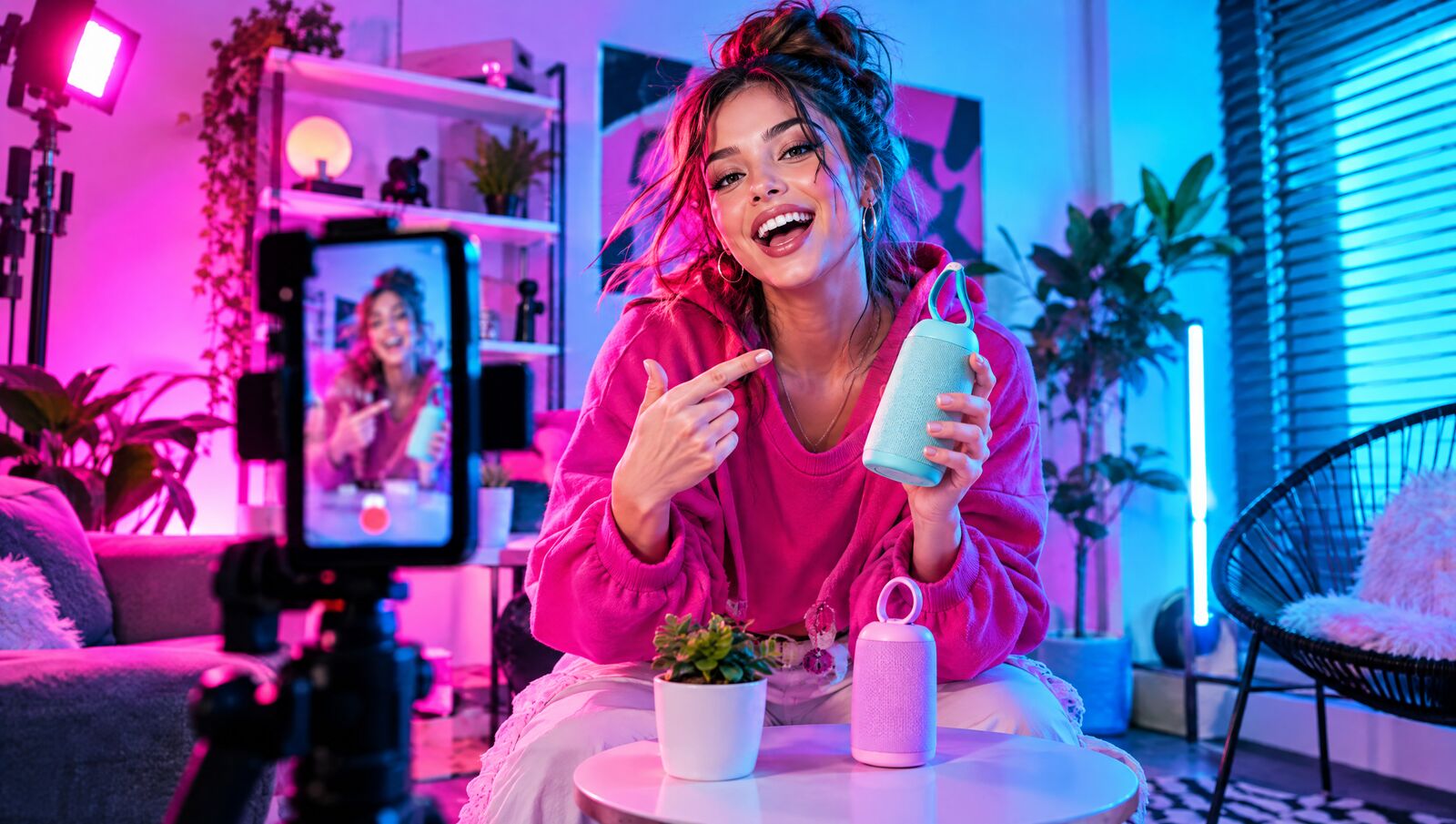
The strongest ads align all three. A person holding up a cracked phone screen (visual), the text “I dropped it from the roof on purpose” (text), and the line “Okay, this case is either amazing or I’m about to be very sad” (verbal) all reinforce the same curiosity loop.
Great hooks share a few characteristics:
- They start mid-action. No “Hey guys,” no logo intro, no slow pan.
- They are specific. “I saved $412 on groceries” beats “I saved money.”
- They create an open loop. The viewer needs to keep watching to resolve it.
- They feel native. They sound like a creator talking, not a brand broadcasting.
The 57 Hooks, Organized by Trigger
Pain and problem hooks (1–8)
These work best for problem-aware audiences who already feel the frustration you solve.
- “If you [frustrating experience], this is for you.”
- “Stop [common mistake]. Here’s why it’s costing you [consequence].”
- “I was so tired of [problem] that I finally tried this.”
- “Nobody talks about how annoying [problem] actually is.”
- “POV: you’ve tried everything for [problem] and nothing works.”
- “This is your sign to stop [painful habit].”
- “The reason your [thing] keeps [failing] isn’t what you think.”
- “If [problem] ruins your [time of day / week], watch this.”
Curiosity hooks (9–16)
These open a loop that the viewer needs to close.
- “I can’t believe this actually worked.”
- “I tested [product] for [time period]. Here’s what happened.”
- “There’s one thing [experts / pros] do that nobody else does.”
- “Wait for it…” (paired with a visual that clearly builds to something)
- “I found the [category] that [surprising result].”
- “This [ordinary object] changed how I [activity].”
- “Here’s what [number] days of [habit / product] did to my [result].”
- “I wasn’t going to share this, but…”
Contrarian hooks (17–23)
These challenge a common belief, which stops viewers who hold it.
- “Unpopular opinion: [common advice] is wrong.”
- “You don’t need [expensive thing] to [desired result].”
- “Everyone says [belief]. They’re missing something.”
- “I stopped [popular practice] and my [result] got better.”
- “[Popular solution] is overrated. Do this instead.”
- “The worst advice I ever got about [topic].”
- “Here’s why I’d never [common choice] again.”
Social proof hooks (24–30)
These borrow credibility from other customers or real results.
- “This has [real number] reviews and I finally get why.”
- “My [friend / partner / mom] wouldn’t stop talking about this, so I tried it.”
- “Reading our most brutally honest reviews.”
- “[Customer type] keep asking me about this, so here it is.”
- “The product our customers reorder the most.”
- “I asked [number] [customer type] what they’d never go back from.”
- “Replying to [commenter]: yes, it really works. Watch.”
Demonstration hooks (31–37)
These let the product prove itself on screen.
- “Watch what happens when I [stress test].”
- “[Thing] before vs. after [time] with [product].”
- “Here’s [task] in [short time] with this.”
- “I put [product] next to [expensive competitor]. Look.”
- “Satisfying [process] you didn’t know you needed.”
- “Let me show you how [product] actually works.”
- “Three ways to use [product] you probably haven’t tried.”
Story hooks (38–44)
These pull viewers into a personal narrative.
- “[Time] ago I was [low point]. Here’s what changed.”
- “I started this business because [personal frustration].”
- “The day I almost gave up on [goal].”
- “My [customer / client] said something that made me rethink everything.”
- “I made a huge mistake with [topic] so you don’t have to.”
- “Storytime: how I accidentally discovered [product insight].”
- “This is the [product] I wish I had when I was [situation].”
Direct callout hooks (45–51)
These name the viewer so they feel personally addressed.
- “If you’re a [specific persona], keep watching.”
- “[Persona], you need to hear this.”
- “This is for the [persona] who [specific behavior].”
- “Calling all [persona] in [location].”
- “Busy [persona]? This takes [short time].”
- “If you have [specific trait / situation], don’t scroll.”
- “Every [persona] should know this before [milestone].”
Offer and urgency hooks (52–57)
These work best for warmer audiences and genuine promotions.
- “This deal ends [real date] and I had to tell you.”
- “Here’s how to get [product] for [real discount].”
- “We’ve never done this before: [real offer].”
- “Try it for [period]. If you don’t love it, [guarantee].”
- “Everything you get for [price], unboxed.”
- “Last time we restocked, it sold out in [real timeframe].”
Pairing Hooks With Visual Openers
The same line lands very differently depending on the first frame. Here is a quick pairing guide we use when briefing creators or filming ourselves:
| Hook type | Strong visual opener | Avoid |
|---|---|---|
| Pain | Creator visibly frustrated mid-task, the messy “before” state | Calm product shot on white background |
| Curiosity | Close-up of something unusual, partial reveal | Showing the full payoff in frame one |
| Contrarian | Creator talking directly to camera, slightly leaning in | Text-only slides with stock music |
| Social proof | Screenshot of a real review or comment, green-screen style | Unattributed star graphics |
| Demonstration | Product already in motion, mid-test | Slow unboxing intro |
| Story | Old photo or footage from the “before” period | Polished brand montage |
| Callout | Creator pointing at camera or at on-screen text naming the persona | Generic lifestyle B-roll |
| Offer | Product with the offer shown clearly as text | Burying the offer at the end |
Pattern interrupts help too: a quick zoom, a sudden sound, a jump cut in the first half-second, or an object moving toward the lens. TikTok’s native editing style rewards energy and movement in the opening.
The AI Prompt We Use to Write 100 More
A swipe file is a starting point. To get hooks that actually fit your product and audience, we use AI with rich inputs. The key is giving it real customer language and clear constraints. Here is our working prompt:
You are a top TikTok performance creative strategist. Write scroll-stopping
hooks for a TikTok ad.

PRODUCT: [name, what it does, price, key differentiator]
AUDIENCE: [who they are, age range, what they care about]
CUSTOMER LANGUAGE: [paste 10-20 real phrases from reviews, comments, DMs]
PROOF WE CAN SHOW: [real results, demos, review counts, guarantees]
OFFER (if any): [real offer and end date]

Write 100 hooks: about 12 for each trigger below.
Triggers: pain, curiosity, contrarian, social proof, demonstration,
story, direct callout, offer.

For each hook provide:
- Spoken line (max 12 words, conversational, no brand name in first 3 words)
- On-screen text (max 8 words, works with sound off)
- Visual opener (one sentence describing frame one)

Rules:
- Sound like a real creator, not an advertiser
- Use specific numbers and details ONLY from the proof section
- No hype words: revolutionary, game-changer, insane, life-changing
- No two hooks may start with the same word
Return as a table grouped by trigger.
Once you have the output, run a quick second pass:
From the hooks above, select the 15 strongest. Score each from 1-10 on:
specificity, curiosity gap, native feel, and relevance to the audience.
Explain the score in one line. Then rewrite the bottom 5 of your top 15
to make them sharper.
A human should still make the final cut. Read each one out loud. If you would not say it to a friend, cut it. For more on building a full AI production workflow around these hooks, see our AI ad creative training.
How to Test Hooks Properly
The cleanest way to test hooks is to hold everything else constant. Film or edit one strong ad body, then create versions that differ only in the first two to three seconds.
- Pick one proven body. Use your best-performing ad, or a solid new script.
- Create 4–6 hook variants from different trigger categories, not five versions of the same idea.
- Launch them together in the same ad group so they compete under the same conditions.
- Read early-retention metrics first. Look at 2-second and 6-second view rates and average watch time. A hook that loses viewers immediately is not worth more spend.
- Confirm with outcome metrics. Once a hook wins on retention, check that it also drives clicks and conversions at an acceptable cost. A hook that grabs attention with the wrong audience can win on views and lose on sales.
Reading the results
Here is an illustrative example of how a hook test might read:
| Hook | 2-sec view rate | 6-sec view rate | CTR | Verdict |
|---|---|---|---|---|
| A: Pain | High | High | Strong | Winner: scale and iterate |
| B: Curiosity | Very high | Low | Weak | Hook overpromises; body doesn’t pay it off |
| C: Social proof | Medium | Medium | Strong | Good for warm audiences; retest in retargeting |
| D: Contrarian | Low | Low | Weak | Cut |
Notice hook B: lots of people stopped, but they left quickly. That pattern usually means the hook made a promise the rest of the video did not keep. The fix is often to adjust the body, not abandon the hook.
Common Hook Mistakes
- Brand-first openings. Leading with your logo or company name signals “ad” instantly.
- Slow starts. Any pause, breath or “so…” before the hook costs viewers.
- Text that is too small or too long. On-screen hooks should be readable in under a second, inside TikTok’s safe zone so the interface doesn’t cover them.
- Testing only one trigger. Six pain hooks are really one test. Spread across categories.
- Retiring winners too early. When a hook fatigues, create new executions of the same angle with a new creator, setting or visual before abandoning it.
- Clickbait without payoff. Hooks that mislead hurt retention, conversions and comments.
Turn Hooks Into a Repeatable System
The advertisers who win on TikTok do not rely on finding one viral hook. They build a system: a swipe file organized by trigger, an AI prompt that turns customer language into fresh hooks, a testing structure that isolates the opening, and a weekly routine of iterating on winners. Save this list, adapt the prompt, and start testing hooks in batches.
Our TikTok ads training covers the full system, from creator briefs and Spark Ads to campaign structure and scaling. You can see how we approach creative across platforms on our AI ad creative page. And if you want coaches reviewing your actual hooks and ads every week, telling you which to cut and which to scale, apply to the AI Ads Coaching Program.